
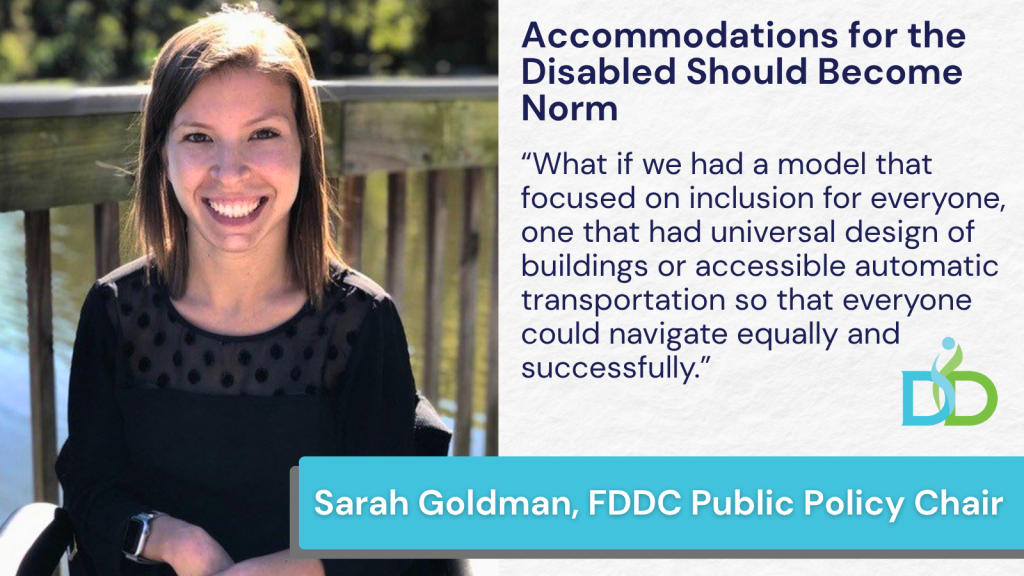
Accommodations for the Disabled Should Become Norm | By Sarah Goldman, FDDC Public Policy Chair
I was born into “generation ADA”, which is anyone born around or after the time the Americans with Disabilities Act (ADA) passed in 1990. I am fortunate to benefit from having curb cuts for my wheelchair, I have the ability to ride almost any form of public transportation with few barriers, and attended and graduated from a public university having been 100% accommodated on campus both within and outside the classroom. I certainly don’t take any of that for granted.
On July 26, the ADA will turn 35 years old, but is it showing its age? Why do I still have to call nail or hair salons to find out if they are wheelchair accessible because they still have steps to enter in? Why doesn’t every building provide equal access such as an automatic door opener so that those with disabilities don’t have to yank heavy doors open while navigating their wheelchair? Why is it difficult for individuals with disabilities to often get hired when the ADA protects against disability discrimination from employment?
Perhaps it is because we may need minimal accommodations to be successful. Perhaps employers are fearful of hiring individuals with disabilities because of preconceived stereotypes.
Perhaps it is because individuals with disabilities are not incentivized to work by our own government. For example, prior to the Working People with Disabilities legislation that went into effect in Florida in 2021, if individuals on Medicaid waivers earned above an income limit of about $30,000 (in Florida) or had more than $2,000 in our bank account at any given time, we would lose our personal care attendants that are only funded through Medicaid. While this legislation has helped incentivize work, it hasn’t eliminated all systemic barriers people with disabilities face around employment. Working full time or having someone shower and dress you is still a common choice we have to make.
Not long ago, I was at a doctor’s office and the doctor looked at me sitting in my wheelchair and then looked at my caregiver and said, “What’s wrong with her?” Boldly, speaking for myself, I said “I have cerebral palsy.”
“What’s wrong with her?” is the lens through which society has been viewing individuals with disabilities for generations. This model views disabled people as a societal burden that suck up government resources. It often claims that disabled people and their need for their mobility aids are the problem.
What if we flipped the view where the issue is not the person with the disability, but with society? What if we had a model that viewed disability not as an individual problem but as a social problem caused by outdated or nonexistent policies, practices, and attitudes?
As we navigated COVID-19, the United States adopted this type of model. Individuals worked from home, attended school online, and had telehealth doctor’s visits. These are some of the reasonable accommodations that individuals with disabilities have been requesting for years. It took a pandemic affecting everyone to make these accommodations the “new normal.” Unfortunately, many of these accommodations have been quickly forgotten as soon as they were not needed by the majority.
What if we had a model that focused on inclusion for everyone; one that had universal design of buildings or accessible automatic transportation so that everyone could navigate equally and successfully?
My life, and the lives of others who are disabled, depend on these advances. I am tired of being seen as a problem. Tired of having to plead for accommodations. Tired of fighting bureaucratic red tape so that I can work full-time and continue to live independently. I want to be able to go out with my friends without calling ahead to confirm accessibility.
It is society that needs to accept and accommodate us. Construct buildings that meet standards with universal design features. Include technology as a standard part of designs; use smartphone technology when installing or
replacing light switches, thermostats, door locks and more. What may be an accommodation for people with disabilities may also provide benefits to others. It is an equal playing field for us all.
We need society to step up. Are you going to choose to blame the individual for needing access or are you going to help advocate for the societal benefits of universal accessibility, inclusion and equality?
Over the next 35 years, I hope society chooses the latter.
Sarah Goldman has used her education and personal challenges living with cerebral palsy to advocate for others with disabilities by contributing to policy initiatives within the Florida Legislature.