
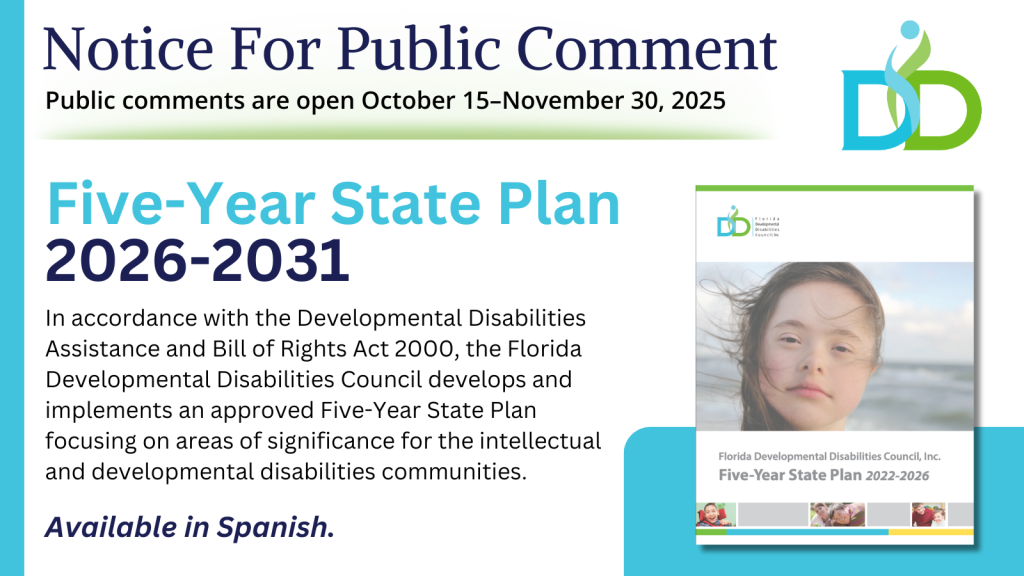
The Florida Developmental Disabilities Council, Inc. (FDDC) is providing the public with an opportunity to review and comment on the Council’s next 5-year state plan. The new state plan will begin October 1, 2026 and end September 30, 2031.
The written public comment period is from October 15, 2025 through November 30, 2025. Please submit public comment via email to [email protected].
There will also be a one-time virtual public comment opportunity via ZOOM on Tuesday December 2, 2025, from 4:00 p.m.-6:00 p.m. In order to participate, YOU MUST REGISTER IN ADVANCE using the link below:
https://us06web.zoom.us/meeting/register/Cgn9oterTCGr50W4HgAZGw
Once you click on the link, you will be asked to provide your name and an email address. Once registered, you will be emailed a link to participate. Please note that during the webinar, each participant will be provided up to five (5) minutes to provide her/his/their comments.
Over the past 18 months FDDC partnered with WellFlorida Council, Inc., one of Florida’s 11 health planning councils, to conduct a comprehensive review and analysis of the primary and secondary data elements required by our federal funding source to determine the priorities and set the direction of the Council’s next 5-year state plan. This included the collection and analysis of federal and state data on I/DD as well as input from over six hundred individuals through structured questionnaires, surveys and focus groups with individuals with I/DD, family members, state agency leaders and leaders in the stakeholder community. The priority areas identified through this process were: Access to Services, Behavioral Health and Challenging Behaviors, and Aging Families. The additional two priorities are standard requirements of our federal funder.
In our May 2025 Council meeting the following priorities, goals and objectives were approved.
PRIORITY AREA 1- ACCESS TO SERVICES
Goal 1: Over a 5-year period individuals with I/DD and their families will have increased knowledge of, and expanded access to comprehensive and high-quality community resources, services and supports across the lifespan.
- Objective 1.1: An Access to Services through Knowledge (ASK) web-based information and resource system will be established, utilized by family members state-wide, and result in increased access for individuals with I/DD and their families to services and supports aligned with their diverse needs throughout the lifespan.
- Objective 1.2: Individuals with I/DD will have increased access to trained qualified, adequately compensated service providers across Florida, especially in rural and underserved communities.
- Objective 1.3: The provision of quality services for individuals with I/DD will be improved through increased access, availability, and use of evidence-based tools for assessing quality assurance so that individuals with I/DD can maintain safe, quality of life in their communities, environments and settings where they are served.
PRIORITY 2- BEHAVIORAL HEALTH AND CHALLENGING BEHAVIORS
Goal 2: Over a 5-year period individuals with I/DD and co-occurring behavioral health needs, including challenging behaviors, and their families will have increased availability of services and supports to manage their behaviors and allow them to maintain a safe quality of life in family homes and community settings.
- Objective 2.1: Individuals with I/DD will have increased geographic access to and availability of trained behavioral health professionals and behavioral services.
- Objective 2.2: Increased use of effective practices for individuals with I/DD will decrease unnecessary interventions and placement in restrictive settings.
PRIORITY 3- AGING FAMILIES
Goal 3: Over a 5-year period aging individuals with I/DD and their families will have increased availability of services and supports needed by an aging population that allows them to maintain quality lives in their communities.
- Objective 3.1: Individuals with I/DD and their family members will have increased access to future planning resources and tools designed to meet the needs of an aging population.
- Objective 3.2: Recognizing the need for human interaction, aging individuals with I/DD and their families will also have increased knowledge of innovative, enabling technology options and models to support housing, social, and health needs.
PRIORITY 4- SELF-ADVOCACY LEADERSHIP
Goal 4: Over a 5-year period the number of individuals with I/DD trained as leaders, providing leadership training for other individuals with I/DD and engaged in cross disability leadership roles and coalitions will be increased.
- Objective 4.1: The state advocacy organization will increase the number of leaders trained, providing leadership training, and engaged in cross-disability coalitions.
- Objective 4.2: Individuals with I/DD and family members will increase their knowledge and impact within public policy and cross disability leadership organizations through Partners in Policymaking (PIP).
- Objective 4.3: Dedicated individuals with I/DD and family member PIP alumni will increase their knowledge and provide evidence of their impact within public policy and cross disability coalitions.
- Objective 4.4: Individuals with I/DD with moderate–severe functional levels will increase their knowledge and participation in public policy activities and/or cross disability leadership coalitions through a specially designed curriculum (PIP Plus),
PRIORITY AREA 5- EMERGENT/EMERGENCY NEEDS
Goal 5: Community inclusion for individuals with I/DD will be maintained or improved through systemic changes and/or provision of essential services and supports at the state, regional, or local level.
- Objective 5.1: One or more emerging/emergency needs will be addressed through one or more systemic changes and/or provision of essential services and supports at the state, regional, or local level.